Sustainability is everywhere in packaging conversations, but talk and formal commitment aren’t the same thing, and a survey done by Altor at recent trade shows suggests the gap is still wide. We polled professionals across functions, companies, and industries to get their attitudes on sustainability and a better understanding of their goals, and the results were interesting.
At recent trade shows, we asked attendees a handful of questions: Does your company have ESG goals for packaging? What makes packaging sustainable? Who in your organization has the most say? The answers came from manufacturers (36%), distributors (28%), service providers (11%), and a quarter from other settings such as universities and pharma. Here’s what stood out.
View the full survey infographic →
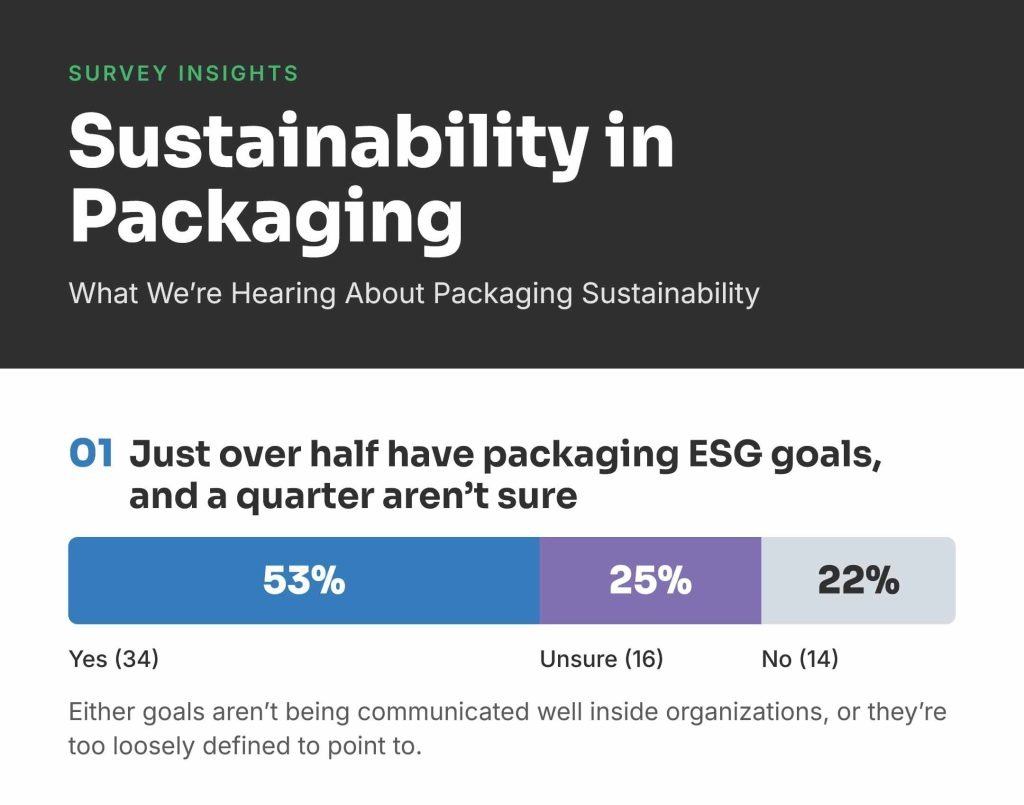
Just over half have packaging ESG goals, and a quarter aren’t sure
Only about half of the people we surveyed say their company has packaging-related ESG goals. 53% of respondents said yes, 22% said no, and 25% said they were unsure.
That last group is worth a closer look. One in four people working with packaging every day (or who were interested enough in packaging to stop by a packaging company’s booth) can’t say whether a goal exists. Either goals are not being communicated well inside organizations, or they are too loosely defined to point to. Both are a problem for suppliers and buyers trying to align on materials and specs. Goals tend to work best when they’re specific enough to guide real design decisions, which is why we like to see design partners brought in early.
Recyclability leads, and views split after that
We asked respondents to select every packaging aspect they consider sustainable. Recyclability topped the list at 80%, roughly 20 points ahead of the next aspect. The full ranking:
- Recyclability: 80%
- Minimizing packaging: 61%
- Recycled content: 59%
- Renewable materials: 56%
- Biodegradability: 53%
- Compostability: 52%
- Reduction of product loss: 47%
The definition is broad: respondents chose four of the seven options on average, and 12 of them (19%) chose all seven. Reducing product loss came last. Packaging that keeps product from being damaged or wasted is arguably one of the most effective ways to improve sustainability, yet fewer than half of respondents counted it.
Protecting the product is a sustainability attribute in its own right. A damaged product means replacement materials, energy, and transportation, and in the cold chain a failed thermal package can mean lost product and reshipments.
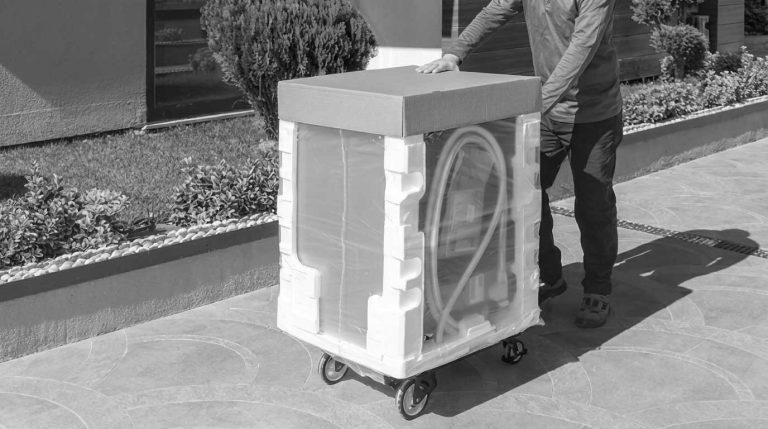
A 2026 life cycle assessment from TNO, commissioned by the European EPS industry association, compared protective packaging for a 50-inch TV and an 80 kg washing machine. Replacing damaged products accounted for roughly 72% of the TV’s climate impact and 59% of the washing machine’s, compared with about 24% and 36% for the packaging material itself. The authors note that the results hinge on assumed damage rates, so treat them as directional. Recyclability is only part of the picture. What happens after use also depends on real-world collection, recycling capacity, and end markets, and materials should be chosen on evidence rather than assumptions.
Who really calls the shots? Engineers and buyers
We asked which function has the most influence over sustainable packaging decisions. Packaging engineering was named most often at 39%, followed by procurement (25%), operations (19%), the C-suite (9%), and the sustainability department (8%).
Engineering and procurement together account for 64% of the answers. In practice, the people choosing specs and suppliers are the ones shaping sustainability outcomes. Sustainability teams may set the goals, but in this sample, they’re rarely seen as the ones deciding.
That makes total cost of ownership a useful shared language for both groups. Freight, labor, packaging efficiency, and reshipment rates all count, not just the price per unit. And a right-sized design, one that is neither under-engineered nor over-engineered, can reduce cost and environmental impact at the same time.
Manufacturers and distributors lead, and interest is outrunning policy
So who’s furthest along? This table shows the share of each group reporting packaging ESG goals:
| Company type | Have ESG goals |
|---|---|
| Manufacturer | 70% |
| Distributor | 61% |
| Service provider | 43% |
| Other (education, pharma, etc.) | 25% |
While this wasn’t a massive survey, these results should be treated as directional. Still, formal goals cluster among manufacturers and distributors.
Among the 14 respondents whose companies have no packaging ESG goals, 86% still count recyclability as sustainable, and they picked 4.5 aspects on average, more than any other group. Among those with goals, recycled content stood out: 71% selected it, compared with 59% overall.
What it means, and what to do about it
- Make goals visible. With a quarter of respondents unsure whether ESG goals related to packaging exist in their organizations, clear internal communication is an easy first step.
- Talk to the deciders. Sustainability conversations work best with packaging engineers and procurement, who hold the most influence in this sample.
- Start with recyclability, then look beyond it. It’s the shared starting point, while product-loss reduction is an under-recognized benefit worth raising.
- Expect a mixed definition of “sustainable.” Few aspects are universal beyond recyclability, so confirm what a customer or partner means before proposing a solution. No material is sustainable in every application, so the best answer is the one you can back up with evidence.
We’ll keep asking these questions. If your team is working through packaging sustainability, we’d love to hear what you’re seeing.
About the survey: 64 responses collected in person at recent trade shows. Respondents are self-selected attendees, so results are directional and not statistically representative of the wider industry. Percentages are rounded.